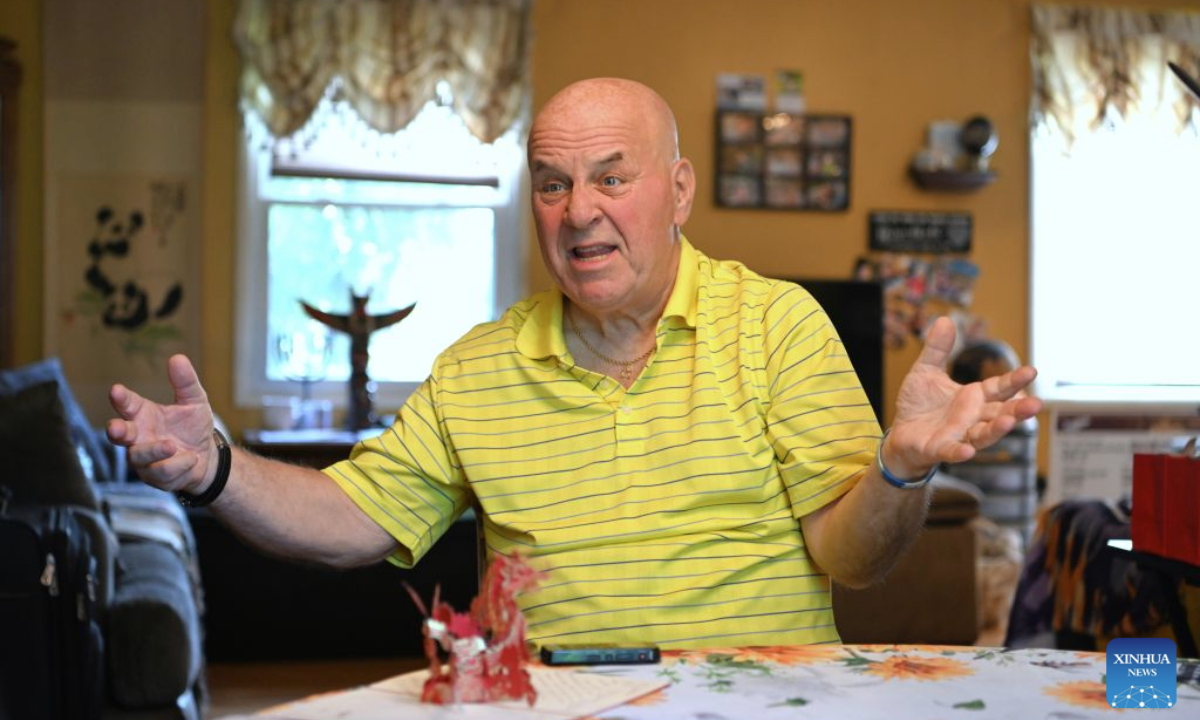
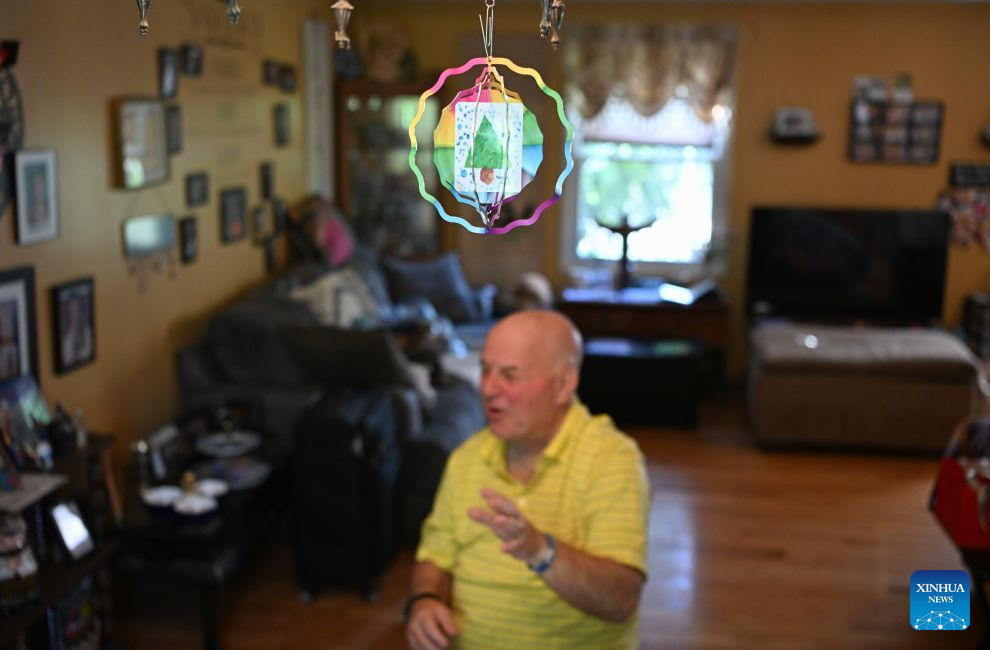
Ronald Sakolsky is interviewed by Xinhua at his home in Plum, a suburb east of Pittsburgh, Pennsylvania, the United States, on June 16, 2026. (Xinhua/Li Rui)Ronald Sakolsky was already waiting on the front lawn as the car rounded the last bend, more than 20 minutes ahead of schedule. "I knew you would come early and sit here until four o'clock and then knock on my door," Sakolsky told Xinhua reporters with a grin. "That's why I was outside." It was, he said, just the way he remembered Chinese people doing things. His waiting outside was a small gesture of thoughtfulness, one that hinted at a friendship forged nearly three decades earlier between a veteran middle school world history teacher from Plum, a leafy suburb east of Pittsburgh, and a rural Chinese woman who devoted decades to holding back the shifting sands of the Mu Us Desert. In 1999, while working as an English teacher in China, Sakolsky was moved to tears by a TV report about Yin Yuzhen, a rural Chinese woman who was trying to hold back the shifting sands of the Mu Us Desert in northern China by planting trees. He spent two months raising 5,000 U.S. dollars to help Yin, then a stranger. Now 69, Sakolsky will return to China this month for his third visit, traveling from Beijing to Luoyang and finally to the Mu Us Desert. He looks forward to reuniting with Yin, giving her a big hug and planting another tree beside her, where shifting sands have given way to a forest roughly 50,000 trees strong. "It's a miracle," he told Xinhua recently. "There's no other word than it's a miracle." A JOURNEY HE NEVER PLANNED Sakolsky's modest two-story home in Plum is not where one might expect an international story to begin. He bought it 32 years ago and raised his family there with Barbara, his wife of 46 years. They have four children and eight grandchildren. High on one living room wall, "The Sakolskys," in large letters, crowns a display of framed family photos surrounding the words: "Family is where our story begins. Life takes us to unexpected places. Love brings us home." Asked to sum up his worldview in three words, Sakolsky answered without hesitation: family, respect, kindness -- the values that have anchored his life. "Family first," he said. "I'm a family man." That makes what he did in 1999 all the more striking. In his forties, in a doctor's waiting room, he spotted a tiny magazine advertisement recruiting Americans to teach English in China. Without hesitation, he applied, flew to New York for an interview, and was offered the position. His parents were stunned and came all the way from Florida to talk him out of it: He had four children and a stable teaching career. His oldest daughter was a high school senior, while his youngest son was entering elementary school. But his daughters supported him. "My dad said, 'You're crazy. How are you going to go away for a year? You have four children, a wife and a house to take care of.' Then he looked at my girls and said to them, 'Are you going to let your dad go to China for that long?'" "And my girls looked at their grandfather, and I'll never forget this. They said to him, "Whatever dad wants to do, we support him." With his family's blessing, Sakolsky left for Beijing, then traveled by train to Luoyang three days later. When he arrived at about 9 p.m. that night, the platform was almost empty and dimly lit. For a moment, he felt uneasy until he spotted two Chinese teachers holding up a piece of cardboard with his name written across it. Teaching at Luoyang Foreign Language School was only one part of Sakolsky's life in China. One of the earliest "lessons" he learned came from watching children kick an empty Coca-Cola bottle between two stones serving as goalposts. At first, he was puzzled by how they could play without a real soccer ball. "Then I realized it didn't matter to them," Sakolsky said. "They could play the game, laugh and have fun with a plastic bottle," he said. "So China taught me to appreciate the simple things in life. You don't have to have a lot of money, you don't have to have a big car and a fancy house, and you can still be happy. That was a big lesson that I learned right away." Beyond the classroom, Sakolsky often volunteered at nearby schools and villages and traveled with Chinese colleagues during school holidays, sharing modest guesthouses, simple meals and long train rides. Sakolsky told Xinhua such experiences helped him break the ice with his Chinese colleagues, who eventually treated him just like one of them. "That's what I wanted," he said. Sakolsky also told Xinhua that shortly after he arrived in China, his hosts gave him a Chinese name, Long Fu, or "Happy Dragon." "I like dragons," he said, laughing, "and I laugh a lot." A MIRACLE HE NEVER IMAGINED Every evening in Luoyang, Sakolsky watched a half-hour English news broadcast before heading downstairs to practice tai chi with elderly neighbors. Then, on an autumn evening in 1999, a brief TV report caught his eye. On the screen was Yin, planting trees by hand with her husband to push back the advancing sands of the Mu Us Desert, he remembered. The story stayed with him. "I was so touched in the heart, I started to cry," he recalled nearly 30 years later. "I honestly cannot tell you why. Something just happened to me. I just felt like I needed to help." Over the next two months, Sakolsky spent his evenings contacting more than a dozen organizations across the United States, determined to help the woman he knew only from that five-minute broadcast. After a series of setbacks, a Boston-based charity agreed to provide a 5,000-U.S. dollar grant with no strings attached. He then spent weeks helping coordinate the cross-border paperwork and communications. By the end of December, word finally came that the money had reached China and was on its way to Yin. "I expected nothing," he said. "You don't give something expecting something in return. I wanted to thank China and help her make China more beautiful. That was all. I didn't need a thank-you or anything else." He heard nothing more about the donation until the following May, when the school told him he needed to take a week off for a trip. When he asked his Chinese colleague, Bai Fan, and the New York-based coordinator of the exchange program where he was going, both gave the same reply: "I know, but I cannot tell you, you will cry." He was flown to Hohhot, the regional capital. At dinner, as Sakolsky sat facing the door, it swung open, and in walked a woman in a pink jacket. "That's the lady from television!" he recalled. "I jumped out of my seat, and I ran up to Ms. Yin and gave her a big hug." The next morning, before an audience of about 500 people, Sakolsky was asked to give an impromptu speech. He remembers little of the 20-minute address except its core message: Americans and Chinese "must focus on our similarities and not on our differences," and can work together to plant a forest in the desert. Afterward, they drove for four hours. "No roads, no timber, no houses," he recalled. "We were just driving over sand dunes in the desert." When the vehicle finally stopped, there was nothing but sand stretching to the horizon. Then Yin emerged from a hollow in the dunes, where she had been digging for water to irrigate her young trees. Yin showed him how to plant the trees, which he thought would grow only about knee-high to hold back the sand. "I never thought that it was going to be a 50,000-tree forest," he said. "Back then, I said this was impossible (turning this desert into a forest), but she did it, she and her helpers." That night, Yin and her husband welcomed him into their home. Nearly three decades later, he still remembers the homemade noodles Yin cooked for him. "Delicious," he recalled softly. Earlier this year, Yin launched an online search for the American teacher who had helped her plant the first trees. The story eventually reached Sakolsky, who was stunned to learn that the forest had grown to roughly 50,000 trees. "Fifty thousand trees!" he exclaimed. "I cannot believe it." Then came photos showing a building and a road where there had been nothing but sand in 1999. "When I go back, I will be amazed," he said. "It's a miracle. There's no other word for it." Sakolsky insisted that Yin was the real hero. "I'm not the hero of this story," he said. "Ms. Yin is the hero. I just helped." "Since she was a child, she always wanted to beautify China. It was a lifetime dream of hers, and she has accomplished her dream," he said. A REUNION HE NEVER EXPECTED For more than two decades, Sakolsky and Yin lost touch, but China never really left him. His home is filled with reminders of those years: a Year of the Dragon card, a calligraphy scroll, paintings of peonies and pandas, a wooden dragon made by his children, and even a pack of cigarettes and a lighter from his first dinner in Luoyang, kept as reminders of Chinese hospitality, though he has never smoked. Downstairs, in the basement, stands a nearly six-foot replica of a Terracotta Army general, a gift he received after returning to teach in Luoyang in 2004. It stood in his classroom for 17 years before he brought it home upon retiring. Now, he hopes his youngest son, also an educator, will one day give it a place in his own office. Based on his experience in China, Sakolsky summed up his impression of the Chinese people in three words: respect, simplicity and patriotism. He called China's decades-long fight against desertification remarkable in terms of both scale and dedication. "China also, with what Ms. Yin did with the forest, taught me how much love the Chinese have for their country," he said. "She was making like no money and still planting the trees. That's what got to my heart." "The fact that Chinese people are willing to sacrifice and give back because they love their motherland is awesome," he added. In June, while traveling in Australia, Sakolsky was recognized by a woman from Singapore who had seen a video about his story. "She was like, 'Oh my god, there are millions of people who have watched this video!'" he recalled, still astonished. "I'm just a simple teacher," he said. "I live a simple life ... I have four fantastic children and eight fabulous grandchildren, and that's what I love. I never thought anything like this was ever going to happen." Sakolsky is set to travel to China for a trip late this week. Asked what he wants to do first when he sees Yin again, he didn't hesitate: "Give her a big hug." He also hopes they can plant trees side by side once more. For Sakolsky, the reunion holds great significance. "We're all humans. We all love our families, we all love life, we all love the Earth. We all want peace," he said. He suggested that everyone can work together to create a peaceful world. "It's not an easy thing, and not a quick thing. It will take time, but it can be done." "(If) the goal is strong enough, and you don't quit every time you face an obstacle, (if) you keep going, (then) you'll reach the goal. That's what Ms. Yin did."
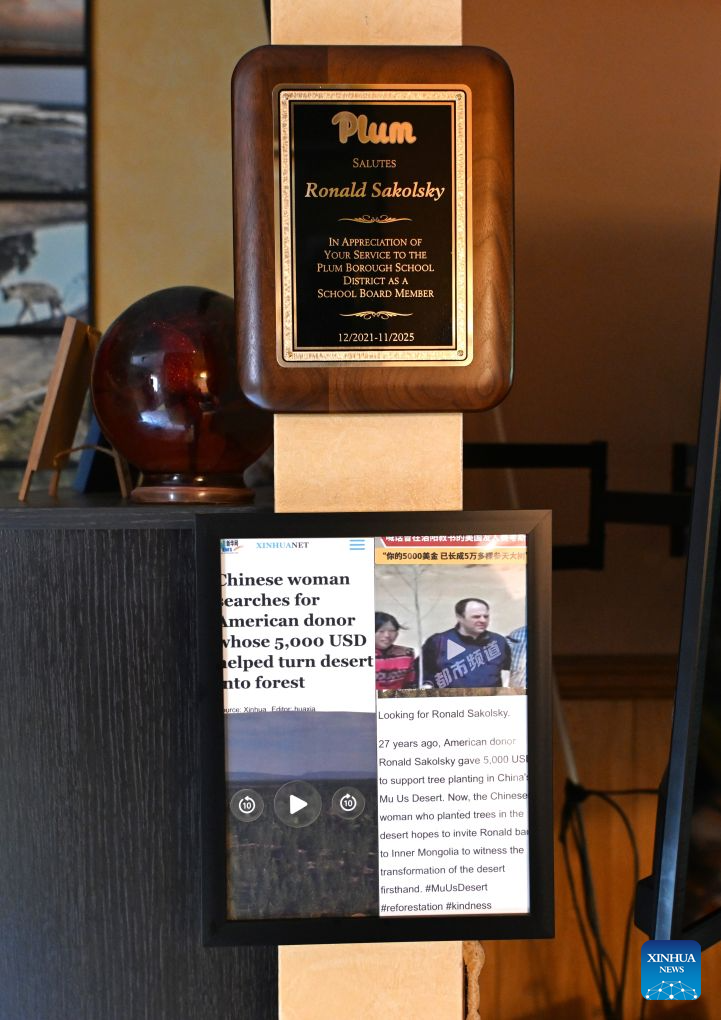
A printout of a Xinhua report about Yin Yuzhen's online search for "Sakolsky" is pictured at Ronald Sakolsky's home in Plum, a suburb east of Pittsburgh, Pennsylvania, the United States, on June 16, 2026. TO GO WITH "Feature: From 5,000 USD to 50,000 trees: an American teacher and a Chinese woman's efforts to green a desert" (Xinhua/Li Rui)
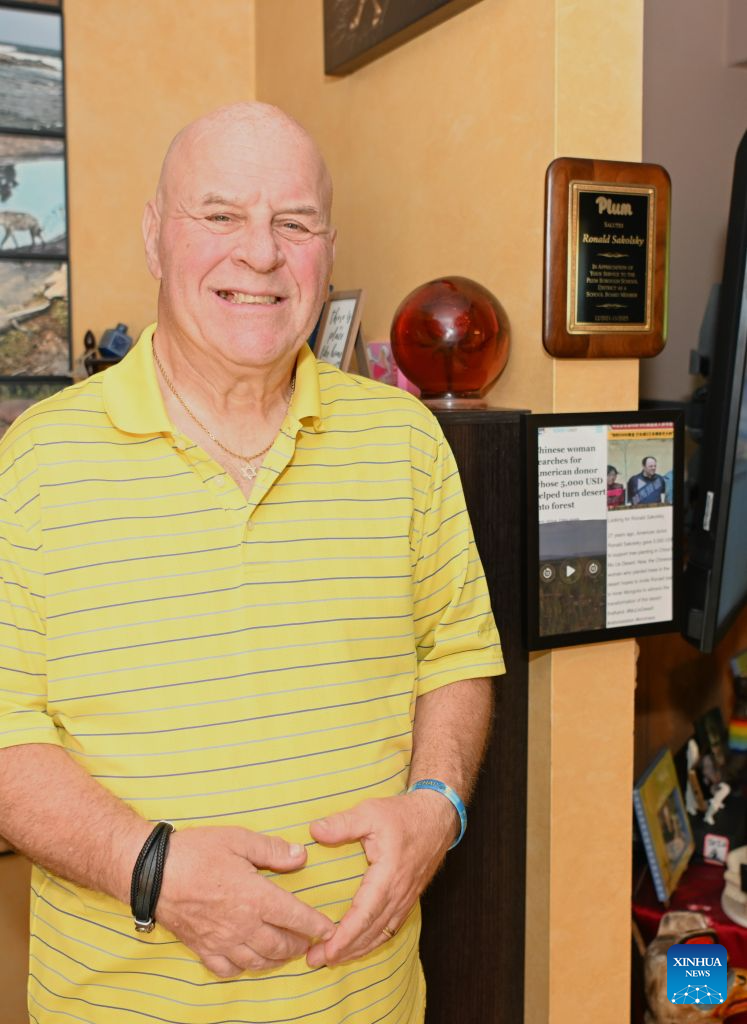
Ronald Sakolsky poses beside a printout of a Xinhua report about Yin Yuzhen's online search for "Sakolsky" at his home in Plum, a suburb east of Pittsburgh, Pennsylvania, the United States, on June 16, 2026. TO GO WITH "Feature: From 5,000 USD to 50,000 trees: an American teacher and a Chinese woman's efforts to green a desert" (Xinhua/Li Rui)
Ronald Sakolsky is interviewed by Xinhua at his home in Plum, a suburb east of Pittsburgh, Pennsylvania, the United States, on June 16, 2026. (Xinhua/Li Rui) 。
世界田径锦标赛将于当地时间7月15日至7月24日在美国俄勒冈州尤金市举行。
B | 作为巴黎奥运周期的第一场综合性田径大赛,中国田径队派出23名男子运动员和30名女子运动员参与23个项目的角逐。北京时间16日凌晨,苏炳添将亮相世锦赛百米大战,这将是他的赛季首秀。新人本届赛事是田径世锦赛首次落地美国,将有1900多名运动员登场亮相,其中包括37名上届世锦赛冠军和42名东京奥运会冠军。
C | 49个参赛项目中,男女35公里竞走取代50公里竞走,首次进入世锦赛。
D | 中国队中,两名东京奥运会金牌得主巩立姣、刘诗颖都将参赛,卫冕冠军刘虹将参加女子20公里竞走比赛。苏炳添除了参加男子100米个人项目,还将带领刚递补获得东京奥运会铜牌的中国接力队在4×100米中争创佳绩。在此次出征美国前,苏炳添在深圳龙岗大运中心备战了5个月。
E | 中国田径队着眼于巴黎奥运会的备战目标,此次在阵容上注重“新老搭配”。中国田径协会负责人表示,为巴黎奥运会储备人才、锻炼队伍是本届世锦赛中国田径队目标之一。出征本届世锦赛的中国队中有10名“00后”选手,以及9名出生于1998年至1999年的运动员。全队平均年龄为26岁,比东京奥运会时下降2岁。上一届田径世锦赛上,中国田径队以3金3银3铜居奖牌榜第4,创下中国田径队继1993年斯图加特世锦赛(4金2银2铜)之后的最佳战绩。中国田径队于5月8日至9日在北京体育大学训练基地开展体能测试,各项目选手近日陆续从国内外训练基地抵达尤金,进行赛前最后的冲刺备战。
F | 争金“谁还嫌冠军多呢?我仍然有更多的目标,希望拿好多的冠军。”第八次参加世锦赛的女子铅球选手巩立姣这样表态。东京奥运会赛场上,巩立姣以创个人最好成绩的20.58米赢得冠军。在尤金,巩立姣将向世锦赛三连冠发起冲击。在她看来,未来3年突破21米绝不是梦想:“21米不是太遥远,其实东京奥运会时,我也没有发挥得特别好,我相信还有没有展现出来的实力,因此很想达到21米的目标。”女子铅球是中国田径队在本届世锦赛上的夺金点之一。除巩立姣之外,张林茹和小将宋佳媛也具备不俗实力。
G | 宋佳媛曾在世锦赛选拔赛中投出20.20米和20.38米的优异成绩。
H | 本届世锦赛,刘诗颖和吕会会将联袂冲击女子标枪冠军。
I | 在2019年多哈世锦赛上,刘诗颖收获银牌。东京奥运赛场上,刘诗颖以66.34米的成绩夺冠。在5月28日中国田径协会举办的世锦赛选拔赛上,刘诗颖掷出62.93米的成绩。